People often discover France through its monuments, landscapes, and cuisine. Yet another side of France exists behind these iconic images. It can be found in workshops, family homes, wineries, and factories that keep traditions—some of them very ancient—alive.
Imagine stepping through the door of a French workshop.
A craftsman is working right in front of you. His movements seem simple, almost natural. Yet each one requires years of practice, patience, and precision. Little by little, the material takes shape in his hands.
C’est aussi cela, découvrir la France : regarder ceux qui la créent.
Du travail des métiers d’art à Paris aux parfums de Grasse, de la dentelle normande aux traditions provençales, le savoir-faire français raconte une histoire différente dans chaque région.
Surtout, il permet de découvrir une destination autrement. Au lieu de simplement observer un lieu, on comprend les personnes, les gestes et les traditions qui contribuent à son identité.
In Paris, the arts and crafts meet the world of luxury
Paris has long been associated with creativity, fashion, and luxury. However, behind the major fashion houses and their creations lie many crafts that often remain invisible to visitors.
Embroidery, jewelry making, featherwork, leather goods, textiles, and interior design are among these artistic crafts that require a high level of technical skill.
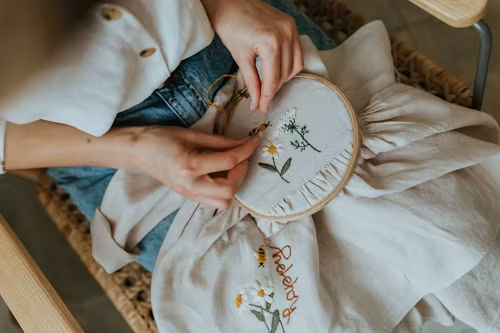
Behind an elegant creation, there is often a craft that isn’t immediately apparent.
For example, a haute couture piece may bring together several different areas of expertise. Some artisans spend long hours working on the details, materials, or finishes. Their contribution may be subtle, but it plays a direct role in shaping the identity of the final creation.
Thus, exploring the world of artisanal crafts in Paris offers a different perspective on French luxury.
Rather than simply admiring a creation behind a store window, travelers can seek to understand how it was conceived and crafted.
Visiting a studio, whenever possible, offers a much more personal perspective on the capital.
Paris thus becomes a city of creativity as much as a city of monuments.
In Champagne, time becomes a true art form
Let’s leave Paris and head to Champagne. Here, French craftsmanship takes on a different form. It begins in the vineyards and continues through many stages before reaching the glass.
The winemaker’s work requires a precise understanding of the terroir, the seasons, and the grape varieties. Each year brings its own conditions, its own challenges, and its own decisions. Then, the work continues in the cellars. That’s where time truly becomes an ingredient.
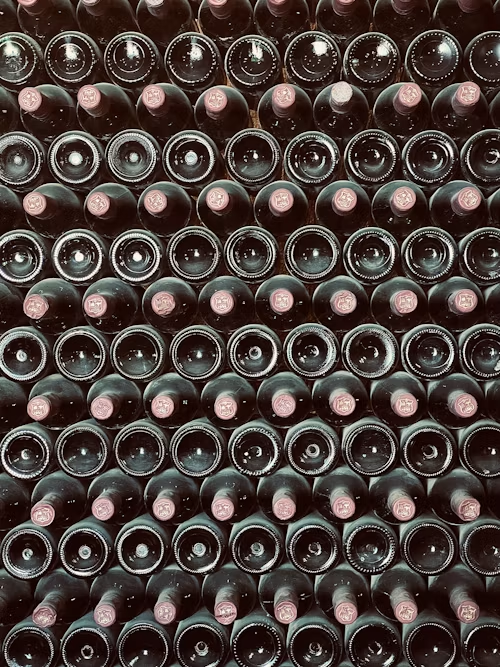
Visiting a vineyard helps you understand what goes into a bottle of Champagne. You learn about the techniques, the decisions, and the people involved in its production.
It’s no longer just about tasting Champagne. It’s about discovering a region and the work of those who know it best.
This approach also changes the way you travel through the region. A tasting can become a genuine encounter, especially when it allows you to speak directly with the winemakers.
Between Reims and Épernay, the landscape thus becomes an integral part of the experience.
Together, the vineyards, villages, wineries, and homes tell a story that goes far beyond that of a single bottle.
In Provence, traditions come to life in the hands of artisans
Provence has an instantly recognizable identity.
Its villages, markets, colors, and landscapes have played a major role in shaping this image. Yet certain traditions offer a chance to discover the region from a more intimate perspective. The santons of Provence are a prime example of this.
These small clay figurines depict characters, trades, and scenes inspired by traditional life. Their creation involves several steps, from shaping to painting and finishing.
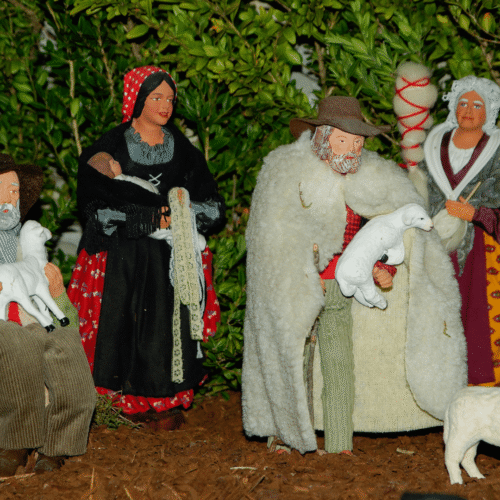
Each santon is thus the result of meticulous work.Visiting this workshop offers a chance to see a different side of Provence. Every year, young people from Provence step into the shoes of artisans to craft santons, which are then sold at Christmas markets to benefit their school. It’s a hands-on way to discover a local tradition and see how it’s passed down to the next generation.
Transforming Glass, Step by Step
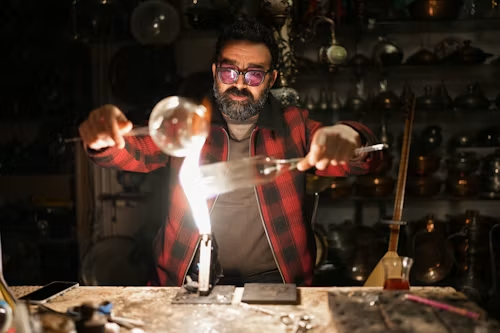
On the French Riviera, craftsmanship can also be discovered through glasswork.
In Biot, the glassmaking tradition allows visitors to witness firsthand how a material transforms under the influence of heat and movement. The process sometimes seems quick. Yet each step requires precision, as the material is constantly changing during the process. The result sometimes seems simple. The process, however, is anything but.
Watching a glass artisan at work allows you to understand something that a store window could never show.
It all begins with a material heated to a very high temperature, which gradually becomes pliable and malleable. Using a long rod, the artisan draws out a small amount of molten glass, then shapes it by gently blowing into the rod and rotating it continuously.
Little by little, the material takes shape. A single movement can alter its shape…Little by little, the material takes shape. A simple movement can alter its thickness, curve, or volume. The artisan then alternates between blowing, precise gestures, and tools that allow him to stretch, cut, or shape the glass before it cools.
In just a few minutes, a shiny, shapeless material is transformed into an object with precise contours.
This transformation creates a particularly fascinating experience for a traveler. One no longer simply discovers a finished object.
Discover a Different Side of France
There are a thousand ways to discover France. Some involve its monuments. Others involve its cuisine, its landscapes, or its history.
Still others simply begin in a workshop. Behind the objects, flavors, and scents lie people, craftsmanship, and stories. That’s precisely what makes French craftsmanship so fascinating to travelers. It offers a glimpse into a more intimate, vibrant, and sometimes unexpected side of France.
At Trip My France, We design custom trips centered on what truly interests you. Culture, cuisine, heritage, encounters, and artisan crafts can all be woven into an itinerary crafted just for you.Because a trip can be so much more than a list of places to visit.
It can be a collection of encounters, experiences, and memories that are truly your own.
Your France. Your story. Crafted around you.