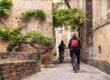
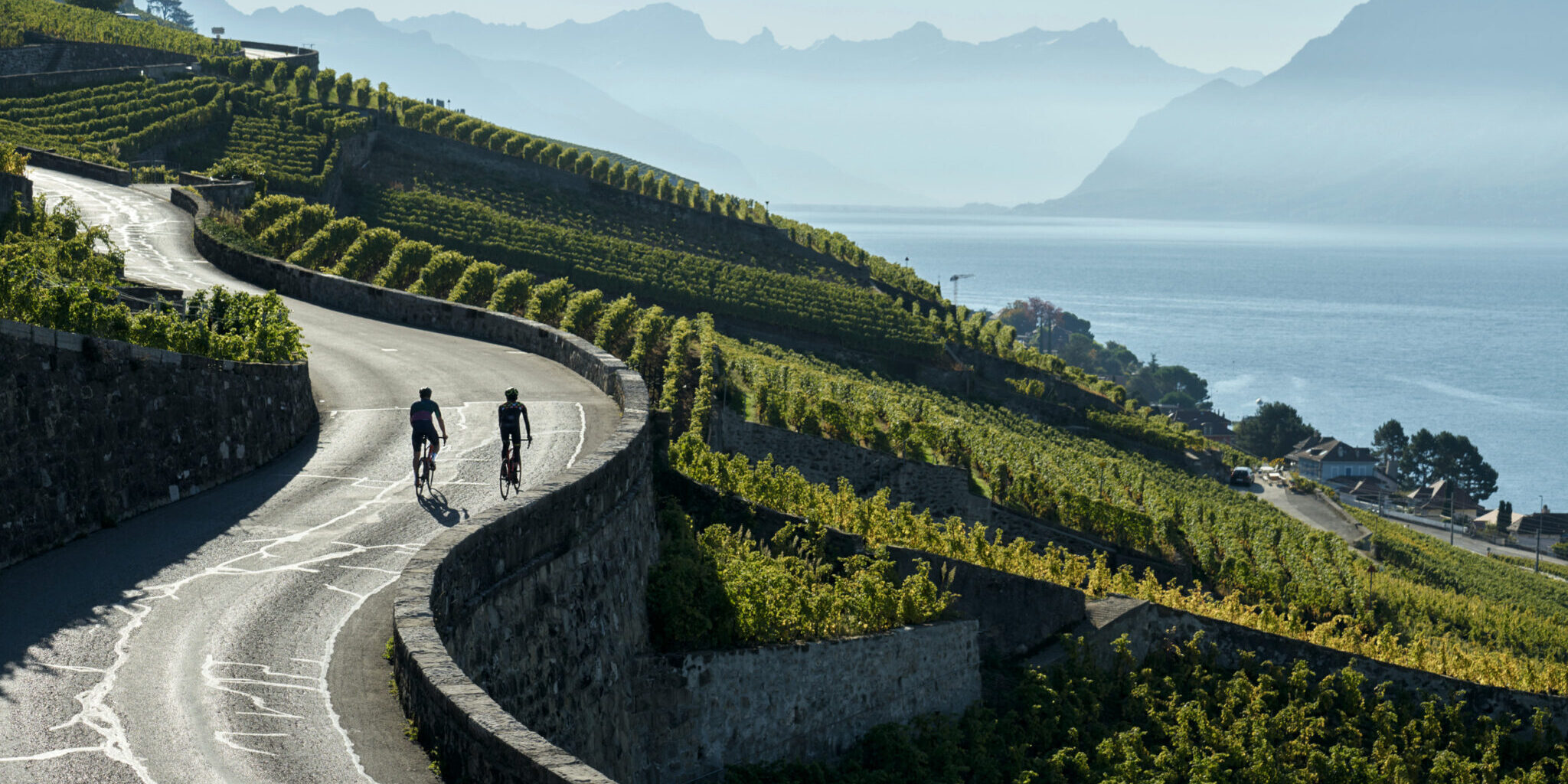
By bike, Switzerland reveals an even deeper dimension, more intimate, almost confidential. From the very first kilometers, something changes. The pace naturally slows down, the gaze lingers on details that would otherwise be ignored. A painted façade in a village along the Rhine, a vineyard clinging to a hillside in Lavaux, the shimmering of a lake at dawn in Montreux or Lucerne. Everything seems in its place, perfectly ordered, but never frozen.
This country, often perceived as discreet, almost reserved, actually reveals itself with unexpected generosity to those who take the time to travel through it slowly. And the bicycle then becomes much more than a means of transport. It becomes a common thread between constantly changing landscapes, between regions different in every valley, between atmospheres that shift from the silence of the Alps to the bustle of cities like Basel, Lausanne or Geneva.
Across four emblematic routes — from Lake Constance to Basel, from Lake Geneva to Geneva, from the Valais Alps to the great central Swiss lakes — the country reveals itself in all its diversity.
Cycling along the Rhine: a gentle journey between water and history
From Lake Constance to Stein am Rhein
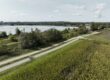
It all begins in an almost peaceful atmosphere on the shores of Lake Constance. The water stretches as far as the eye can see, sometimes blurring the gaze between lake and horizon. In the morning, a light mist may still hover above the water, giving the start an almost suspended atmosphere. The air is mild, slightly humid, and the first pedal strokes immediately create a feeling of fluidity. Very quickly, the Rhine becomes a discreet but constant travel companion. It is almost never out of sight or earshot. The route crosses villages perfectly integrated into this waterway.
From Schaffhausen to the Rhine Falls
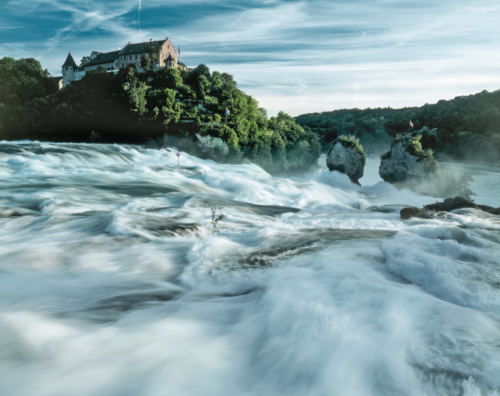
Continuing towards Schaffhausen, the landscape remains gentle but gradually becomes more intense. The hills open up, the banks widen, and the river takes on a different dimension. One begins to sense that something is coming. Then, without gradual transition, everything changes at the Rhine Falls. The sound arrives first, even before the water appears. And suddenly, the river literally explodes into the landscape. After kilometers of calm, this contrast is almost physical. One naturally stops, drawn in by the power of the place.
From Rheinfelden to Basel, between nature and urban life
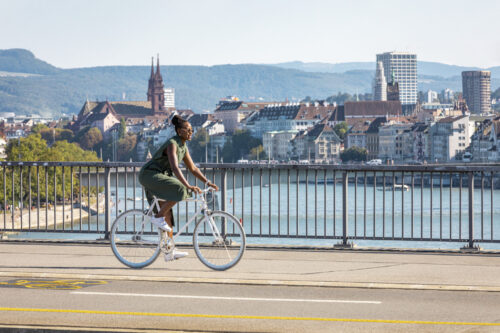
After Schaffhausen, the Rhine regains a form of calm, but the scenery begins to change. One crosses more open areas, more spaced-out villages, then the region of Rheinfelden, where the river becomes wider, more settled. Approaching Basel, the atmosphere gradually shifts toward the city. The banks become more developed, the footbridges more frequent, and urban life sets in without abrupt rupture. Basel then appears as a natural transition, an art and culture city where the Rhine remains a living axis at the heart of the landscape.
Cycling Lake Geneva: an elegance between nature and the art of living
From Lausanne to Yvoire, between Switzerland and France
Lake Geneva immediately imposes its presence. From Lausanne, the journey begins at the port of Ouchy, where the city opens directly onto the water. Very quickly, one leaves the urban bustle to follow a wide, luminous shoreline where the gaze constantly alternates between lake and mountains. Between Lausanne and Morges, the rhythm becomes even more fluid. Small beaches, discreet ports and lakeside promenades create a feeling of perfect continuity. One does not pass through cities; one glides between them. Then the journey crosses the border into France. Yvoire then appears like an almost unreal interlude, a medieval village facing the lake, where every alley seems to slow down time.
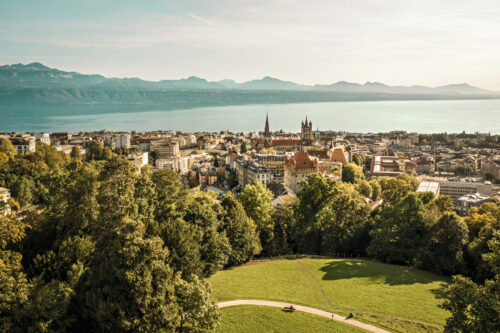
From Yvoire to Geneva, between lake and Geneva vineyards
The return towards Geneva is gentle, almost without visible transition. The city gradually reappears, first in the distance, then more and more present. Geneva asserts its international status, but remains deeply connected to the lake. From the city, the route then leaves the shoreline to enter the Geneva vineyards. In Satigny, Russin and Dardagny, the landscape changes completely. The lines become more agricultural, the roads more winding, and the vineyards take over. One moves from a lacustrine world to a more rural, almost secret Switzerland.
From Geneva to Nyon, back to the shores
Descending back toward the lake, Nyon reappears as a familiar landmark. The castle still dominates the town, and the lakeside regains its gentle activity, made of walkers, boats and changing light. The route toward Lausanne is particularly pleasant. Nothing is rushed. The landscape feels known, yet never identical. Each passage offers a variation of light, a different nuance on the water.
From Lausanne to Montreux, the Swiss Riviera
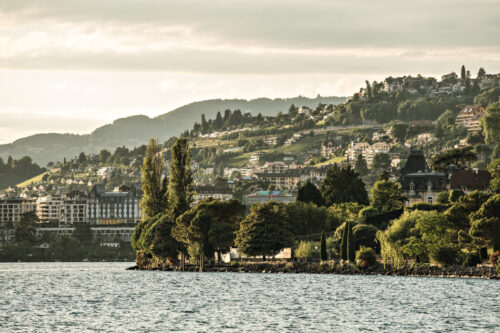
The return toward Lausanne mainly marks the entry into one of the most beautiful stretches of Lake Geneva. The Lavaux vineyards regain all their intensity. The terraces sculpt the mountain, and the lake below seems even more vast. Vevey then brings a more urban and cultural atmosphere, before Montreux concludes this section with its unique ambiance. Here, everything seems softer: palm trees, flowered quays, historic hotels and evening light. Chillon Castle, between Montreux and Villeneuve, marks a final highlight, set between water and mountain like an emblematic image of Lake Geneva.
The Rhône route: a powerful journey in the heart of the Alps
From Oberwald to Brig, at the source of the river
From the very first moments in Oberwald, the tone is set. Here, the mountain is not a backdrop; it is a total, almost enveloping presence. The peaks tighten, the cliffs become more vertical, and the air takes on a particular freshness, almost sharp. The Rhône is still only a newborn torrent, coming from the glaciers of the Grimsel and the Furka. One follows it through a mineral landscape where rock and water seem to constantly interact. The Goms valley accompanies this initial descent with surprising gentleness, between dense forests, isolated meadows and small wooden villages clinging to the slopes. As the kilometers pass, the valley gradually widens. Then Brig appears, like a gateway to a more structured, more human Valais. The river then begins to change its nature.
From Brig to Sierre, a widening valley
Between Brig and Sierre, the Rhône calms down. It becomes wider, more stable, and the Upper Valais valley gradually opens up. At times, the villages seem perched between sky and valley, as if suspended above the river. The landscape subtly evolves: the mountains remain present but move slightly apart, letting in more light. The Rhône itself gains confidence, as if it is gradually finding its place in the valley.
From Sierre to Martigny, the Valais of vineyards and light
Between Sierre and Sion, then on to Martigny, the valley changes completely in atmosphere. The Rhône crosses here one of the brightest sections of its course. Sierre marks the entrance into wine country. Terraced vineyards stretch across the slopes, perfectly organized, almost geometric. The landscape becomes warmer, more open, almost southern. Sion brings a strong historical dimension with its two castles dominating the valley. Around it, life is organized between orchards, villages and vineyard slopes. Further on, the valley continues to widen toward Martigny, where the Rhône begins to take on a calmer appearance, ready to leave the Alpine world to join Lake Geneva.
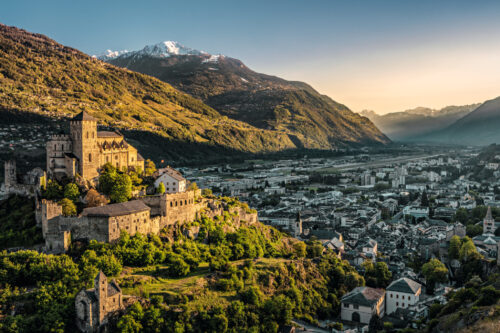
From Martigny to Vevey and Montreux, the Rhône meets Lake Geneva
After Saint-Maurice, the landscape shifts. The Rhône leaves the mountains almost invisibly, but radically. The valley opens up, the relief softens, and the water changes direction. The first wetlands of the Chablais announce the proximity of the lake. Then, gradually, the shores of Lake Geneva appear, first discreet, then increasingly clear. Montreux then emerges with its unique Swiss Riviera atmosphere. Palm trees, lively quays and reflections on the lake create an almost Mediterranean ambiance. Vevey extends this softness with a more cultural and lively character, always oriented toward the water.
From Vevey to Nyon and Prangins, between the lake and the La Côte vineyards
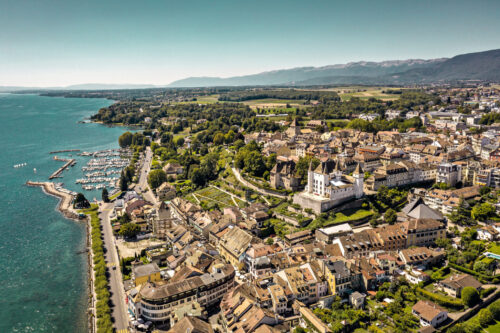
Along Lake Geneva, the route becomes even smoother. Lausanne, Morges, Rolle and then Nyon rhythm the shoreline with almost natural continuity. The La Côte region provides a gentle transition between lake and hills. Vineyards stretch out, punctuated by perched villages and wine estates. Here, everything feels more settled, more harmonious. Nyon marks an important balance point. The castle still dominates the lake, while the town maintains a lively but peaceful atmosphere.
From Nyon to Geneva, an open ending to the world
The final stretch toward Geneva unfolds in a more open, more international atmosphere. The lake gradually widens, becoming almost maritime. Geneva slowly appears, between international institutions, lakeside parks and views of Mont Blanc. The city marks the end of the Rhône, where the river finally merges into Lake Geneva.
A complete valley, from glaciers to lake
This Rhône route offers a true cross-sectional reading of Switzerland. In just a few days, one moves from the glaciers of Oberwald to the international shores of Geneva, crossing completely different worlds but all connected by the same river.
From Vevey to Lucerne: a crossing between dream and reality
From Lake Geneva to the first mountains
The departure from Vevey takes place in a soft, almost elegant atmosphere. Lake Geneva accompanies the first kilometers, faithful and calming, while the first heights of Lavaux already outline the rest of the journey. Very quickly, one leaves the shores to enter a more internal Switzerland. The roads gently rise toward the Pays-d’Enhaut, and the landscape gradually changes. Villages become more spaced out, valleys wider, and mountains begin to assert themselves.
From Gruyères to Gstaad, between traditions and mountains
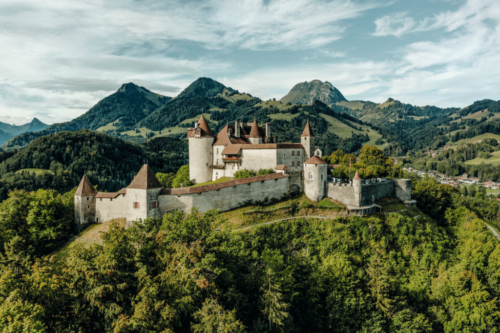
The Gruyères region marks a first strong shift. The castle dominates a rolling landscape where pastures and cheese dairies still set the rhythm of local life. Towards Bulle and then the Pays-d’Enhaut, the ascent becomes more noticeable. The landscapes gain intensity up to Gstaad and Saanen, where the world becomes fully Alpine. Impeccable chalets, high-altitude meadows and nearby peaks create the impression of an almost ideal Switzerland.
From Spiez to Interlaken, between two worlds
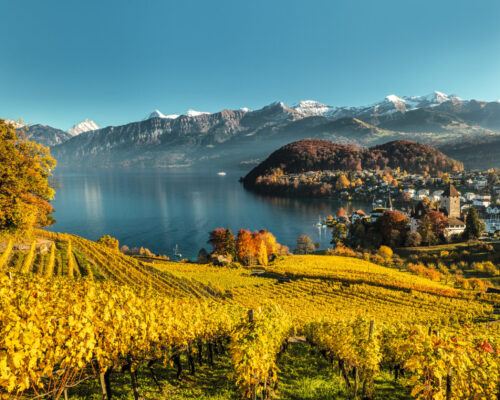
The descent into the Simme valley opens a new sequence of the journey. Then Spiez appears, with its castle and its direct opening onto Lake Thun. Here, the landscape changes scale. The lake becomes immense, deep, framed by the Bernese Alps. Interlaken, located between Lakes Thun and Brienz, acts as a true junction point between different dimensions of the Swiss landscape.
From the Brünig to Lucerne, central Switzerland
After Interlaken, the climb to the Brünig Pass marks an important transition. The altitude changes, as does the pace. Then the descent toward Sarnen and Lake Lucerne gradually brings a softer, more open Switzerland. Lucerne finally appears, set on its lake, surrounded by mountains. Its famous wooden bridge, its colorful façades and its elegant atmosphere give the journey a perfectly balanced conclusion.
A Switzerland in multiple worlds
This route between Vevey and Lucerne gives the impression of crossing several countries in a single journey. Each valley, each lake and each ascent tells a new facet of the country, without ever breaking the continuity of the route.
Cycling in Switzerland, a country discovered in motion
Across these four routes, Switzerland appears as a country that never lets itself be grasped in a single glance. It reveals itself gradually, through contrasts, at the rhythm of valleys, lakes and passes. But what connects all these journeys above all is the rhythm of the bicycle. A slow, steady rhythm that allows one to feel the transitions, to see landscapes evolve and to absorb atmospheres. Distances take on a different value, reliefs become natural stages, and lakes obvious pauses.