Provence, Loire Valley and Dordogne: three unforgettable journeys
Spring is a special season for cycling trips. It is a transitional period when nature awakens after the winter months, when the days gradually get longer, and when temperatures become ideal for physical effort. Traveling by bike at this time means enjoying a unique atmosphere. Unlike summer, often marked by heat and heavy tourist crowds, spring allows you to discover regions in much more pleasant conditions. The roads are quieter, the landscapes greener, the villages more peaceful. It is the perfect time to slow down, take your time, and fully experience cycle touring.
In France, certain regions are particularly well suited to this season. Provence, the Loire Valley and Dordogne each offer a different experience, but all share the ability to combine landscapes, culture, and the pleasure of cycling.
Cycling in Provence
An ideal playground for cycling enthusiasts
Provence is a region particularly suited to cycling, notably thanks to the diversity of its routes. Cyclists will find a wide variety of paths, ranging from hilly roads with significant elevation gain to more accessible routes that allow for a gentler exploration. The routes mainly follow small secondary roads, away from major traffic axes. This is a real advantage, as it allows you to ride in a calm environment with little traffic. This tranquility is essential to fully enjoy a cycling trip, as it offers the freedom to ride at your own pace, to stop whenever you wish, and to take the time to observe your surroundings without constraint.
Varied landscapes along the routes
On the ground, cyclists move through varied landscapes that change along the routes and regions crossed. In the Luberon, around villages such as Bonnieux, Ménerbes or Lacoste, the roads cross vast agricultural areas where vineyards play an important role. The plots are very structured, with rows of vines forming regular lines across hillsides and plains. In the Alpilles area, particularly around Saint-Rémy-de-Provence, landscapes alternate between vineyards and olive groves. These landscapes are especially visible when riding between the different villages in the region.
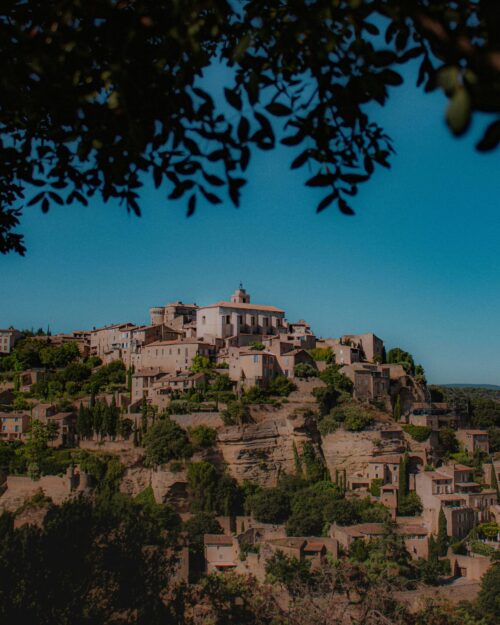
Further east, toward Mont Ventoux, the scenery becomes even more diverse. Approaching Vaison-la-Romaine, cyclists cross more extensive agricultural zones, with cultivated fields that change appearance with the seasons. In spring, these plots are often in full growth, with strong green tones contrasting with the lighter soils of drier areas. The terrain plays a central role in the experience. Routes regularly climb to higher elevations, whether on the foothills of the Luberon, in the Alpilles, or toward Mont Ventoux. These climbs provide access to open viewpoints over valleys, villages, and surrounding landscapes. From these elevated positions, cyclists can observe perched villages such as Gordes or Les Baux-de-Provence, and sometimes more distant mountain ranges.
Cyclists also pass through natural areas typical of Provence. On many routes, especially around the Luberon or the Alpilles, you ride through garrigue landscapes. This low vegetation is composed of aromatic plants such as thyme, rosemary, or wild lavender. In other areas, the routes pass through wooded zones. Cyclists then ride under pine trees, holm oaks, or white oaks, providing shade and a feeling of freshness, particularly appreciated on sunny spring days. These wooded sections offer a different atmosphere, calmer and more shaded, in contrast with the open garrigue or cultivated areas.
This alternation between agricultural landscapes, natural areas, and varied terrain helps make each route dynamic. Over the course of a single day, cyclists can move from one environment to another. This constant diversity is one of the main characteristics of cycle touring in Provence and fully contributes to the richness of the experience.
Villages and heritage visible at every stage
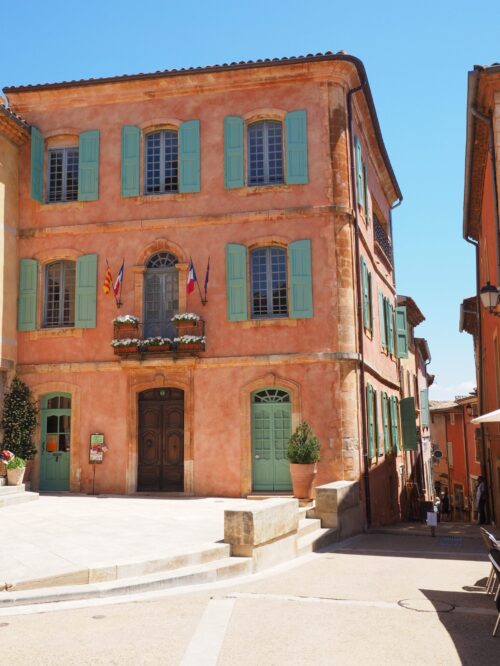
Along the route, villages play a central role in the experience. They are often visible from afar, perched on heights or nestled in valleys. As you approach, the roads become narrower, and then you enter historic centers made up of tight streets and stone buildings. These villages offer a particular atmosphere, with houses built of light-colored stone, colorful shutters, and tiled roofs. Among the villages cyclists can discover along the routes are emblematic places such as Gordes, perched above the Luberon and listed among the most beautiful villages in France, or Roussillon, known for its ochre cliffs with red and orange tones. Further west, Les Baux-de-Provence dominates the Alpilles and offers a spectacular setting, with its medieval ruins and impressive viewpoints over the region. Other villages such as Bonnieux or Lacoste, also located in the Luberon, fit perfectly into cycling routes, with their sloping streets and open panoramas over surrounding valleys. In the Alpilles, villages like Saint-Rémy-de-Provence offer a softer atmosphere, with lively historic centers and shaded squares where it is pleasant to stop. The main squares of these villages are generally lively, with a fountain, a church, or a few local shops.
Some villages are particularly remarkable due to their location. Perched villages, such as Gordes or Les Baux-de-Provence, are often situated on elevated terrain and require a climb to reach them. This climb can represent an effort, sometimes sustained depending on fitness level and the type of bike used, but it is always rewarded by the view once at the top.
A deeply rooted cultural heritage
Provence is not limited to its natural landscapes. It also has a rich cultural heritage that can be discovered throughout cycling routes.
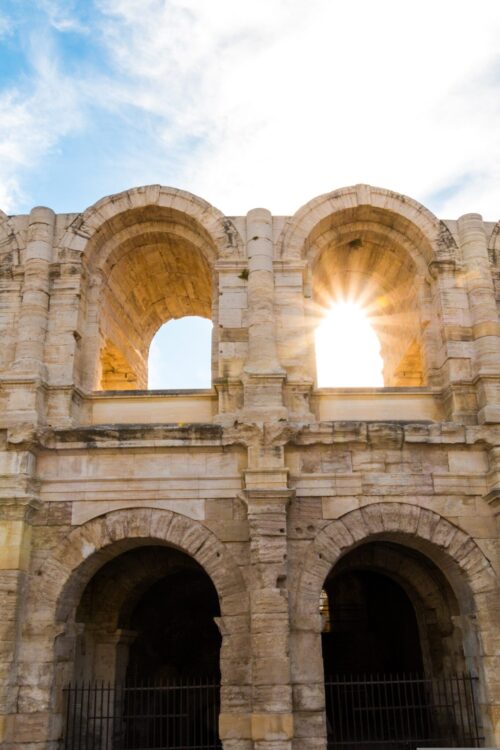
Cyclists pass through cities and emblematic sites that reflect the region’s history. Avignon, with its famous Palais des Papes, illustrates the historical power of the papacy and constitutes a major point of interest on the route. Arles, with its arenas and ancient theater, recalls the influence of Roman civilization and offers a concrete glimpse into the region’s ancient history. The villages of the Luberon, meanwhile, bring a more intimate dimension to discovery. They are characterized by their narrow streets, stone constructions, and integration into the landscape. Cycling through these villages allows you to feel a particular atmosphere, linked to local history and Provençal traditions.
Each stage of the journey thus becomes an opportunity to discover a different facet of Provence. Between architecture, history, and local traditions, heritage naturally integrates into the route and enriches the overall cycling experience.
Cycling in the Loire Valley
An emblematic route along the river
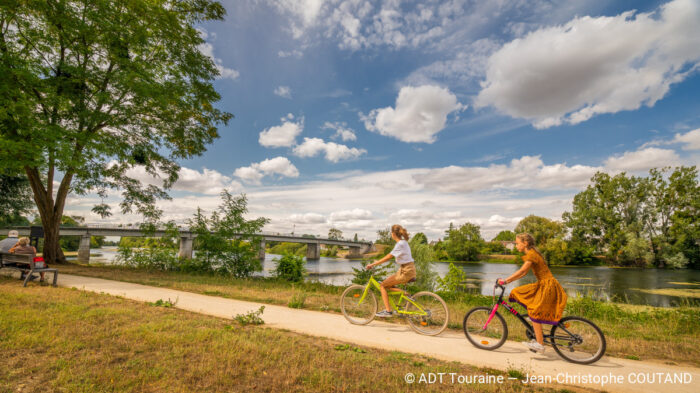
The Loire Valley is one of the most emblematic destinations for cycle touring in France. The route follows the course of the country’s longest river, the Loire, crossing a wide variety of landscapes and territories. The itinerary is particularly well suited to cyclists, as the terrain is generally flat, with little elevation gain, allowing long distances to be covered without major difficulty.
On the ground, cyclists move along the river, following its banks or moving slightly away to cross villages and agricultural areas. The landscapes along the Loire are very varied. In some sections, particularly around Tours or Amboise, the river is wide and bordered by sandbanks, with open natural areas. Further upstream or downstream, you pass through more wooded zones, with alluvial forests and shaded paths. This alternation creates a gentle progression, where each stage brings a new atmosphere. Cycling along the Loire means moving through a calm environment, where the rhythm is dictated by the river itself.
Castles, symbols of exceptional heritage
The Loire Valley is particularly known for its castles, which line the route and constitute major points of interest throughout the journey. They are often visible from the roads or accessible via short detours by bike, allowing them to be naturally integrated into the itinerary.
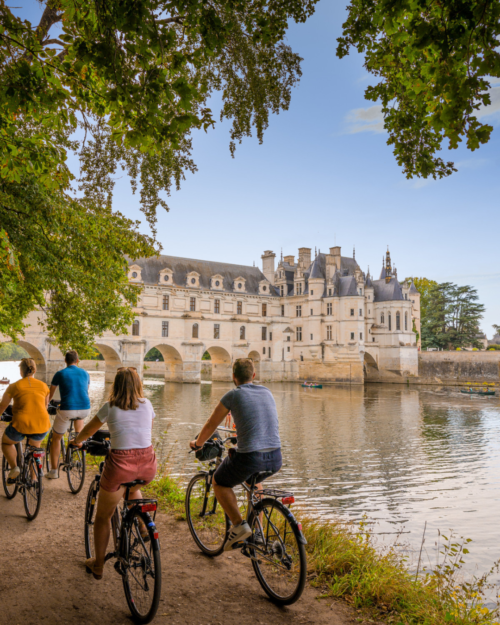
The Château de Chambord, located in the forest domain of Sologne, is one of the most impressive. Surrounded by vast natural spaces, it stands out for its unique architecture and immense park. Further west, the Château de Chenonceau, built over the Cher River, is directly visible from the water and offers a very distinctive perspective, with its arches spanning the river. In the Amboise area, cyclists can discover the Royal Château of Amboise, located on a height, as well as the Clos Lucé, former residence of Leonardo da Vinci. In Blois, the château overlooks the town and offers a clear view of the surroundings, while its architecture reflects several historical periods.
These castles are not just monuments to visit. They are an integral part of the landscape, and discovering them by bike allows you to understand them in their context, surrounded by nature, forests, or vineyards.
Accessible landscapes and a smooth experience
One of the great strengths of the Loire Valley lies in the ease of travel for cyclists. The routes are designed to be accessible, with well-marked sections and suitable infrastructure. This allows for peaceful travel, whether you are a beginner or a more experienced cyclist. Cyclists cross agricultural areas, particularly around towns such as Saumur or Tours, where you can observe crops, orchards, and vineyards. In some sectors, especially in the Loire Valley listed as a UNESCO World Heritage site, the landscapes are preserved and offer great visual harmony. The villages crossed are also numerous. Places like Amboise feature historic centers with old houses, cobbled streets, and lively squares.
A gentle and accessible experience
Cycling in the Loire Valley means moving through an environment where heritage and nature constantly coexist. This alternation helps make the route pleasant and balanced. The bicycle becomes an ideal way to connect sites, taking the time to observe and discover.
Cycling in Dordogne
An immersion in a preserved territory
Dordogne offers a different, more intimate experience, where cyclists move through a largely preserved rural environment. The routes cross varied landscapes, often organized around valleys, rivers, and plateaus.
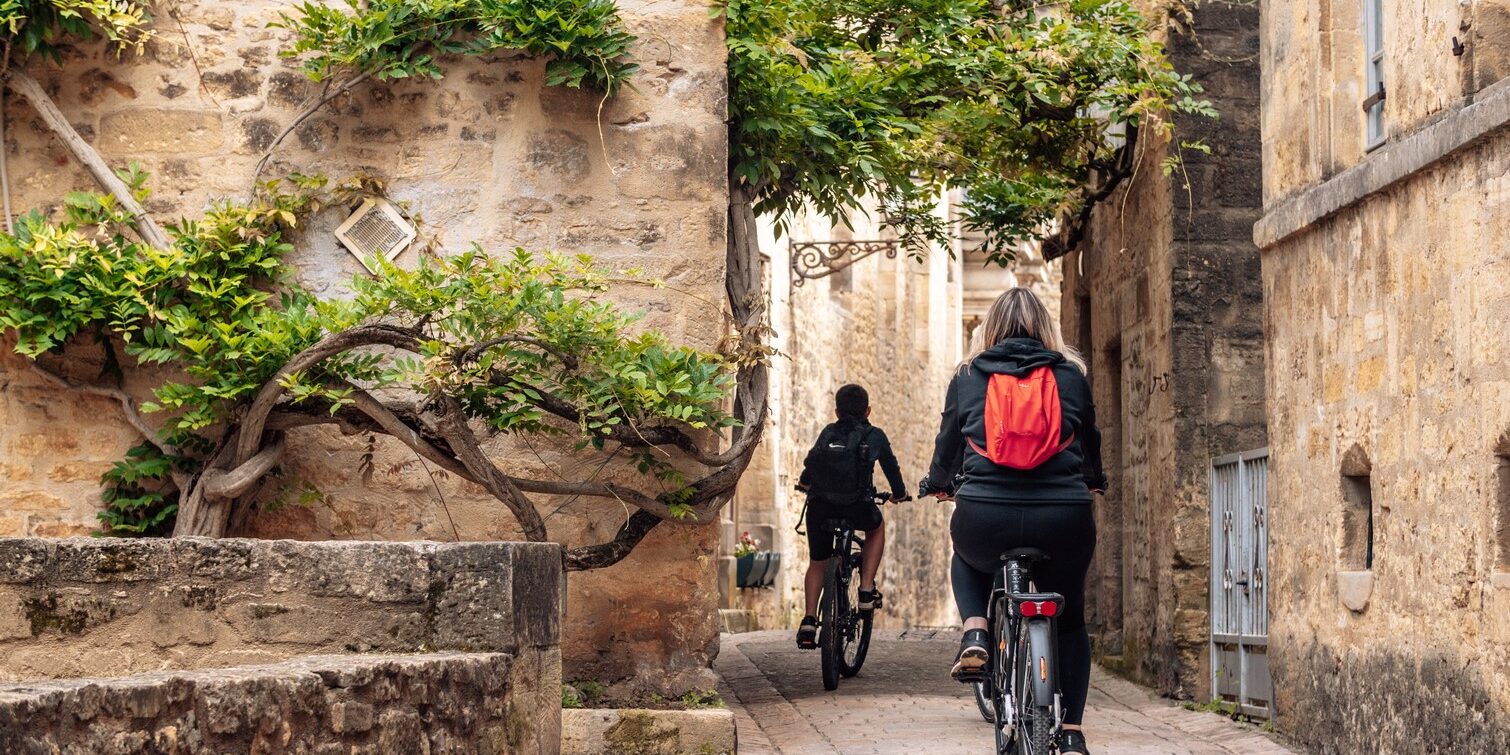
Along the Dordogne Valley, for example around La Roque-Gageac or Beynac-et-Cazenac, the roads follow the river and offer regular viewpoints over the water, cliffs, and villages set on heights. The limestone cliffs are very characteristic of the region, particularly in the Vézère Valley, around sites such as Les Eyzies-de-Tayac or Montignac. They give the landscape a strong vertical dimension, with pale rock faces contrasting with the surrounding vegetation. Between these cliffs and rivers, the valleys are generally lush, with meadows and wooded areas. The roads used by cyclists are mostly secondary roads, lightly traveled, winding between villages and natural spaces. This allows riding in a very calm atmosphere, with little traffic and a feeling of isolation in some sections. Nature is omnipresent, and each stretch of road offers a different ambiance, whether in a narrow valley, on a plateau, or near a perched village.
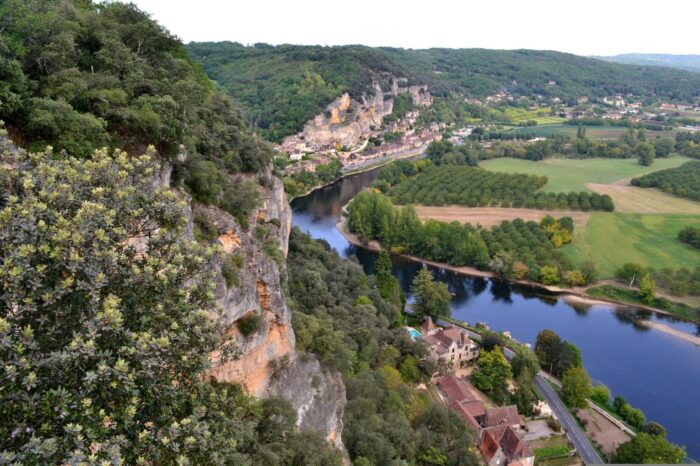
Cycling in Dordogne means moving through a rural France where the pace is slower and where distances between points of interest invite you to take your time. The terrain, although less pronounced than in some regions, is still present with regular climbs and descents, particularly around villages such as Sarlat-la-Canéda, where roads alternate between valleys and plateaus.
A region steeped in history
Dordogne is also a region deeply marked by history. It is home to some of the most important prehistoric sites in the world, particularly in the Vézère Valley. Places like the Lascaux cave, located near Montignac, testify to human presence for millennia.
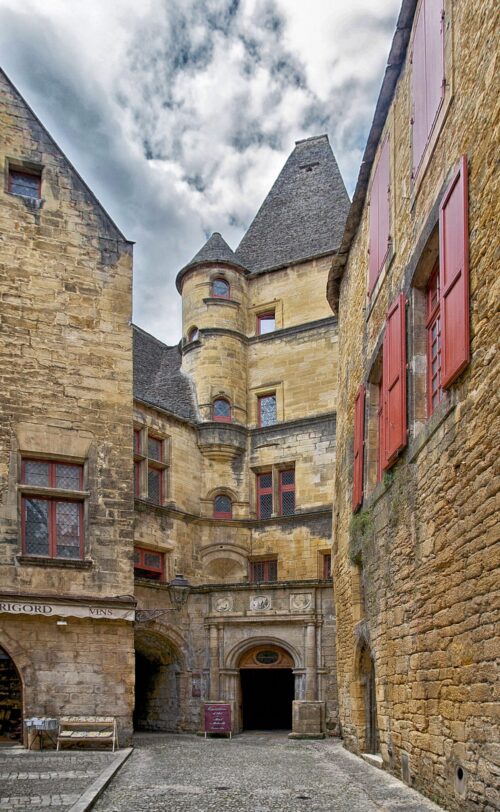
Along the routes, cyclists also pass through numerous villages and medieval bastides, such as Sarlat-la-Canéda, with its remarkably preserved historic center, or Monpazier and Domme, which illustrate the typical layout of bastides with their central squares and geometric streets. Castles also play an important role in the landscape, particularly along the Dordogne Valley. The Château de Beynac, perched on a cliff, or that of Castelnaud-la-Chapelle, located opposite Beynac, offer a concrete glimpse into the medieval history of the region. Each stage of the journey thus becomes a reading of the territory through the centuries, where remnants of the past coexist with present-day landscapes.
An essential gastronomic experience
Dordogne is also a region renowned for its gastronomy, which is an integral part of the cycling experience. Cyclists pass through agricultural areas where many emblematic ingredients of Périgord are produced, such as walnuts, foie gras, and truffles.
Local markets play a central role in the region’s life. In towns like Sarlat-la-Canéda or Bergerac, they allow you to discover a wide variety of local products directly from producers.
Three destinations, three ways to experience cycling
Choosing between Provence, the Loire Valley, and Dordogne is above all choosing a travel experience. Provence offers a bright and contrasted immersion, the Loire provides a gentle and heritage-focused discovery, while Dordogne invites a historical and gourmet exploration. In all three cases, the bicycle becomes a true means of discovery, allowing you to experience the territory in a slower, closer, and more human way. Spring, with its ideal conditions, provides the perfect setting for this type of experience. Traveling by bike at this time ultimately means giving yourself a timeless break, where every landscape, every encounter, and every stage takes on a special dimension.