
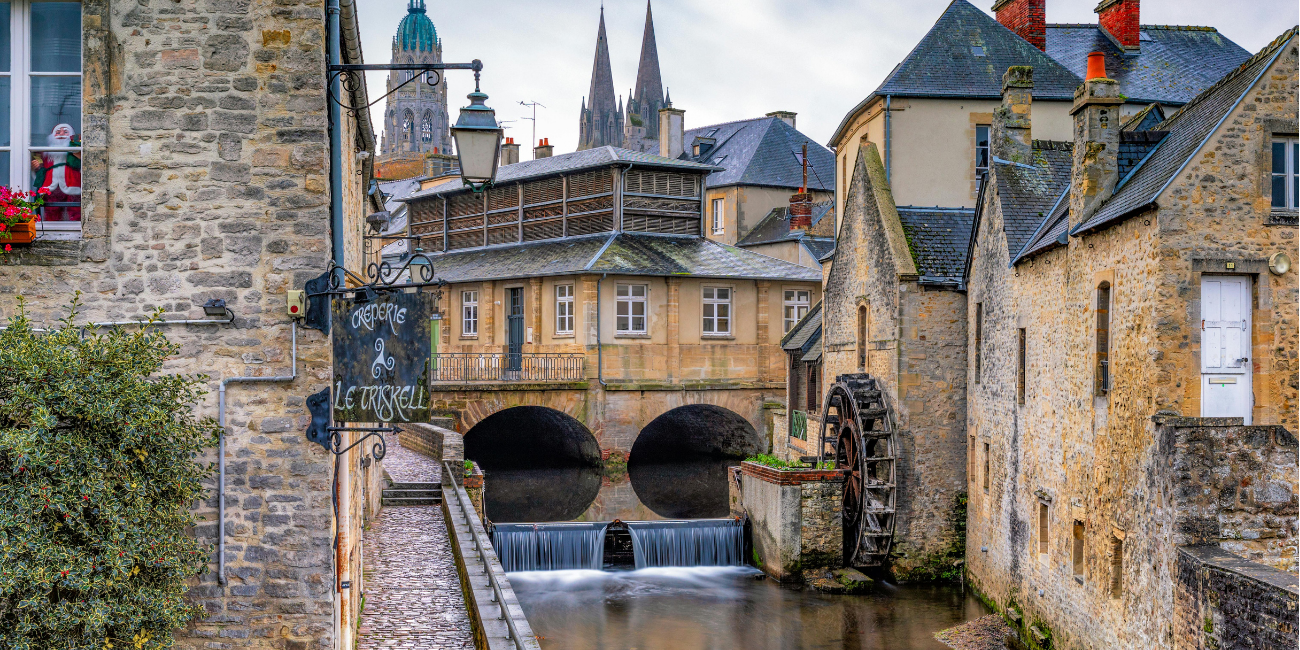
Between medieval heritage, the memory of the Second World War and peaceful landscapes, Bayeux is one of the finest stops for discovering Normandy. Located just a few kilometres from the famous D-Day beaches, the town charms visitors with its well-preserved architecture, historic streets and landscaped walks along the Aure.
A day in Bayeux makes it easy to move from an iconic monument to a charming little street, then finish with a walk along the water or a moment of reflection in one of the region’s most important military cemeteries.
Here are the must-see places to discover when visiting Bayeux and the D-Day beaches.
Bayeux Cathedral
It is impossible to begin a visit to Bayeux without admiring its spectacular Notre-Dame Cathedral. Located in the heart of Old Bayeux, it dominates the town and is one of the finest examples of Norman religious heritage.
The cathedral was consecrated in 1077 in the presence of William the Conqueror and his wife Matilda. Begun in the Romanesque period, the building subsequently evolved towards the Gothic style over the centuries. This architectural history explains the richness of its details and the coexistence of several styles. Inside, take the time to observe the nave, chapels and crypt, a particularly interesting remnant of the original Romanesque building. The light filtering through the stained-glass windows also creates a very distinctive atmosphere.

A Monument Closely Linked to the Bayeux Tapestry
The cathedral also has a historical connection with the famous Bayeux Tapestry. Commissioned by Odo of Conteville, Bishop of Bayeux and William the Conqueror’s half-brother, this work tells the story of the conquest of England in 1066. Although the tapestry is now displayed in a dedicated museum, its history remains deeply associated with the cathedral and the town.
Strolling Along Rue des Cuisiniers
After the cathedral, let yourself be guided through the small streets of the historic centre. Among them, Rue des Cuisiniers is particularly worth a visit. This street perfectly illustrates the charm of Old Bayeux. The old façades, shops and restaurants allow visitors to discover a town that has preserved much of its historic character.
Bayeux was fortunate to be largely spared the destruction that affected other Norman towns during the Second World War. As you walk through the centre, you can therefore observe half-timbered houses, private mansions and various traces of its medieval past.

An Ideal Street for a Gourmet Break
Rue des Cuisiniers is also an interesting place to discover the gastronomic atmosphere of Bayeux. After several cultural visits, it is the perfect place to take a break over a coffee, pastry or lunch. Take the time to walk without a precise itinerary: one of the pleasures of Bayeux is precisely getting lost in its small streets and gradually discovering its heritage.
Discovering the Old Watermill on the Aure
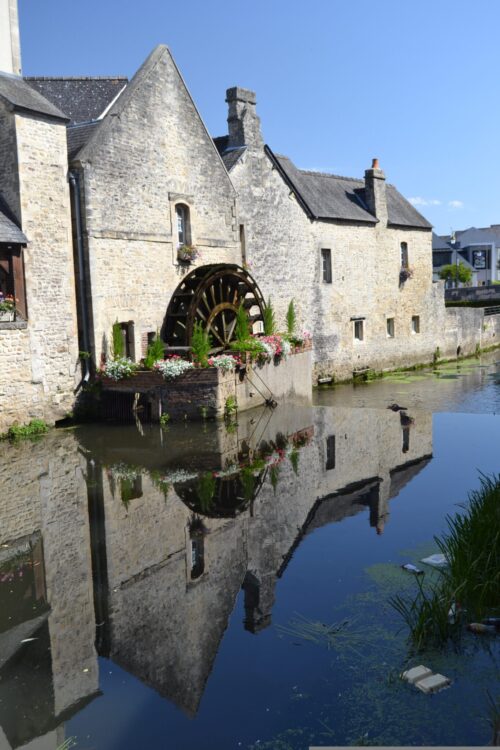
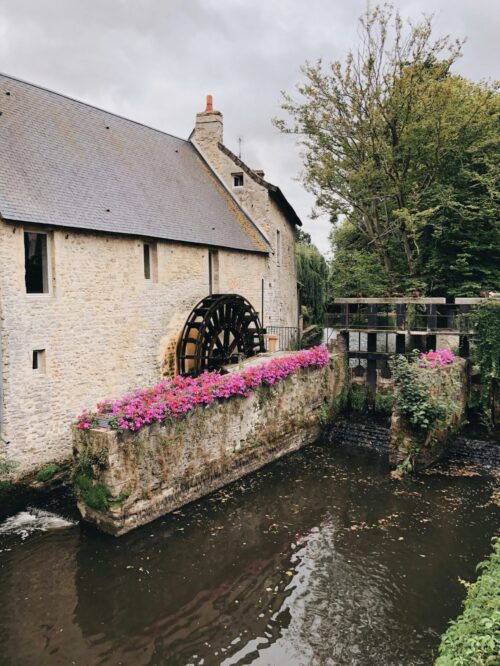
The Aure, the river that runs through Bayeux, plays an essential role in the town’s charm. Along the water, old mills, washhouses and buildings bear witness to the craft activities that once operated along its banks. Among the notable features along the route is the old watermill, which recalls the historical importance of the river in local economic life. The water once provided an essential source of energy for the town’s activities. Today, these old structures are mainly appreciated for their picturesque character.
Another Side of Bayeux
This part of the town offers a pleasant contrast with the historic monuments. After admiring the cathedral and exploring the streets of the centre, returning to the river allows you to slow down and enjoy a much more peaceful atmosphere.
It is also one of the best places to take a few photographs of Bayeux from a different perspective.
Bayeux Commonwealth War Cemetery
A visit to Bayeux cannot be separated from the history of the Normandy D-Day landings. The Commonwealth War Cemetery is one of the town’s most important places of remembrance. The British military cemetery in Bayeux is the largest British military cemetery in France dedicated to those who died during the Second World War. Approximately 4,144 Commonwealth service members are buried there. The site is impressive for its tranquillity and the sober rows of white headstones. A visit naturally encourages silence and reflection.
A Place of Remembrance in the Heart of Bayeux
Bayeux holds a special place in the history of June 1944. The town was the first major town in mainland France to be liberated after the D-Day landings and was largely spared the fighting that destroyed other areas. The cemetery helps visitors better understand the human cost of the Battle of Normandy and is an important complement to visiting the museums and D-Day beaches.
Leaving Bayeux to Discover the D-Day Beaches
One of the great advantages of visiting Bayeux is its proximity to the main D-Day sites. Located around ten kilometres from the coast, the town is an excellent base for exploring the beaches and historic sites of 6 June 1944. Among the must-see places are Omaha Beach, Gold Beach, Juno Beach, Arromanches, Pointe du Hoc and the various military cemeteries.
Omaha Beach and the American Cemetery
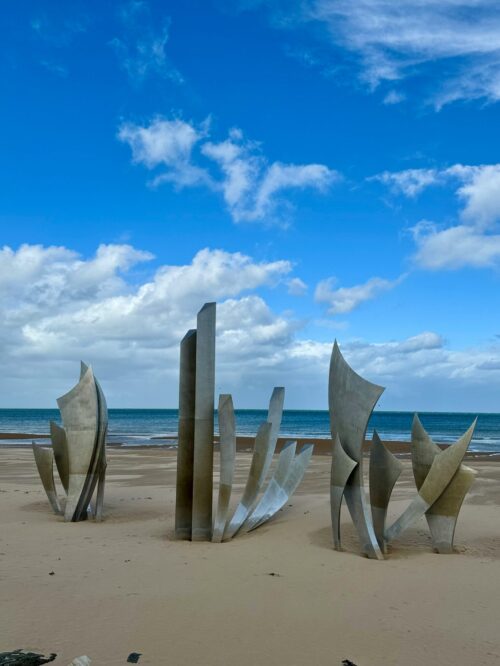
Omaha Beach is probably one of the best-known D-Day sites. The area makes it possible to understand the scale of the operations of 6 June 1944 in concrete terms. Nearby, the American cemetery at Colleville-sur-Mer contains the graves of thousands of American soldiers who died during the D-Day landings and the Battle of Normandy. From Bayeux, the site can also be reached by public transport depending on the season.
Arromanches and Gold Beach
Further east, Arromanches-les-Bains allows visitors to discover one of the great engineering achievements of the D-Day landings: the artificial harbour built by the Allies. The site is particularly interesting for understanding the considerable logistics required for the landing and supply of Allied forces.
Juno Beach and Canadian Remembrance
Juno Beach is associated with the Canadian forces involved in the D-Day landings. The Juno Beach Centre is an ideal place to explore this part of history in greater depth. An excursion from Bayeux can therefore provide an opportunity to discover several aspects of D-Day, from the beaches to the museums and memorials.
Why Choose Bayeux as a Base?
Bayeux offers several advantages for a stay in Normandy.
First, its heritage is exceptionally well preserved. The cathedral, old houses, small streets and banks of the Aure form a particularly pleasant area to explore on foot. Secondly, the town allows visitors to combine several historical periods. In just a few hours, you can go from the Middle Ages to the history of 1944, before enjoying a peaceful walk along the river. Finally, its geographical location makes it easy to explore the D-Day beaches. Tourist offices also present Bayeux as an ideal gateway to the D-Day sites.
A Destination Accessible Without a Car
It is also possible to explore part of the region without a car. Transport services connect Bayeux with various coastal sites, and some seasonal routes serve several tourist attractions associated with the D-Day landings. For cycling enthusiasts, routes also make it possible to reach the coast from Bayeux.
What to See in Bayeux, Normandy?
Visiting Bayeux is much more than discovering a stopover town before heading to the D-Day beaches. Notre-Dame Cathedral, Rue des Cuisiniers, the former installations associated with the Aure, the riverside walk and the Commonwealth War Cemetery make up a rich and varied itinerary.
Then, leaving the town centre, the D-Day beaches allow you to continue this discovery through the landscapes and memorial sites of the Battle of Normandy. Bayeux therefore offers a rare balance between medieval heritage, nature, gastronomy and historical remembrance. Whether you have one day or several days, this town is an excellent base for discovering one of the most fascinating areas of Normandy.







1 Comment