
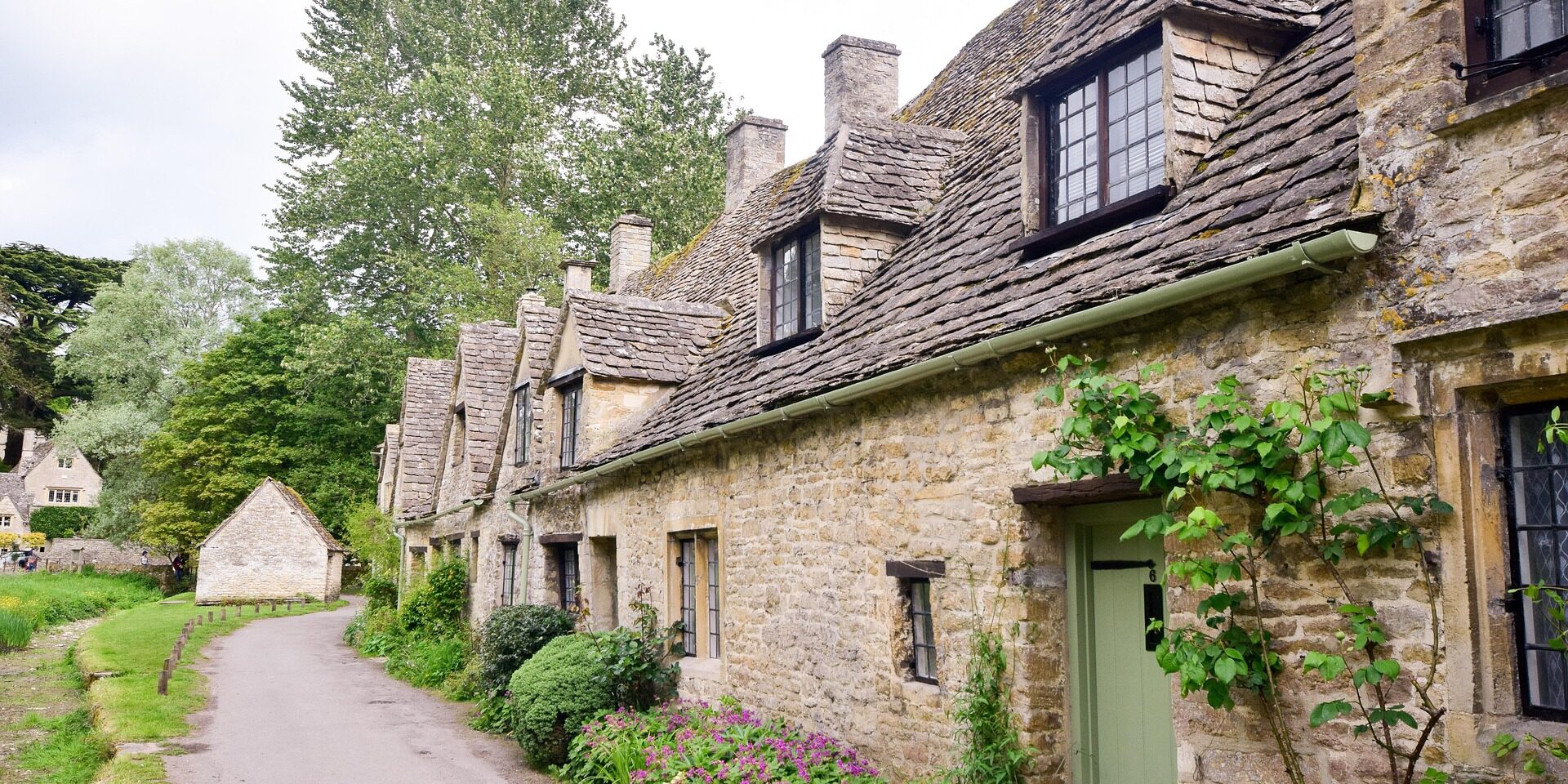
When people think of England, London often comes to mind immediately. Yet, all it takes is leaving the capital behind to discover a countryside of exceptional beauty, where picturesque villages, historic towns, and rolling landscapes reveal another side of the United Kingdom. Between the famous Cotswolds, the university city of Oxford, the elegant streets of Bath, and the mysteries of Stonehenge, this eight-day itinerary invites you to explore the heart of England.
This journey is an immersion into British heritage, blending history, traditions, and nature. From honey-colored stone cottages to royal castles, Arthurian legends, and the remains left by the Romans, each stop unveils a new chapter in English history.
Day 1: Arrival and the First Landscapes of the Cotswolds
After your arrival at the airport, a private driver takes you to one of the country’s most beautiful regions: the Cotswolds. The journey already offers a glimpse of the iconic English countryside, with its lush green hills, sheep-dotted meadows, and charming villages connected by winding roads.
The Cotswolds, the Symbol of the English Countryside
Covering nearly 2,000 km², the Cotswolds are designated as an Area of Outstanding Natural Beauty, a status that protects some of the United Kingdom’s most remarkable natural landscapes. The region is famous for its honey-colored limestone villages, flower-filled gardens, medieval churches, and gentle hills that seem to have come straight out of a Jane Austen novel.
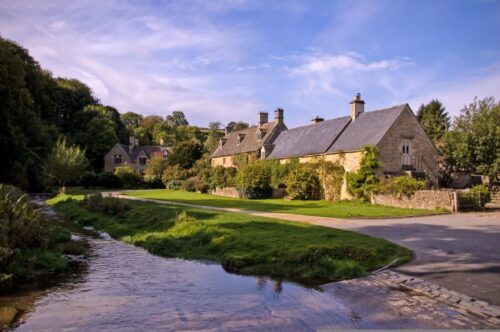
The prosperity of the Cotswolds dates back to the Middle Ages, when the wool trade brought wealth to many villages. Merchants invested in the construction of elegant manor houses, imposing churches, and market squares that still stand today. This remarkable preservation of heritage makes the Cotswolds one of the most popular destinations for history lovers, photographers, and nature enthusiasts.
Day 2: The Most Beautiful Villages of the Cotswolds
This day is dedicated to discovering the iconic villages that have made the Cotswolds internationally famous.
Bibury, a Picture-Perfect Setting
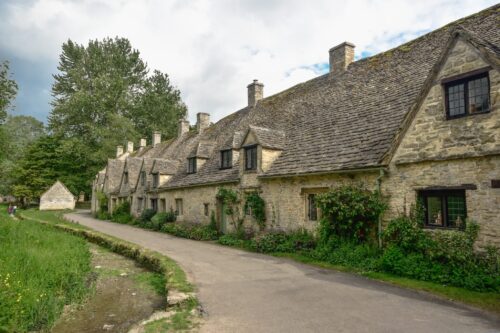
Often described as “the most beautiful village in England,” Bibury immediately charms visitors with its peaceful atmosphere. Crossed by the River Coln, the village is famous for Arlington Row, a row of stone cottages built in the 17th century that has become one of the most iconic images of the United Kingdom.
Originally, these houses were home to wool weavers, whose trade was the region’s main source of wealth. Today, Arlington Row is one of the most photographed sites in England and regularly features in tourism campaigns promoting the country. A walk along the river also offers the opportunity to observe local wildlife and enjoy the timeless tranquility of the village.
Bourton-on-the-Water, the “Venice of the Cotswolds”
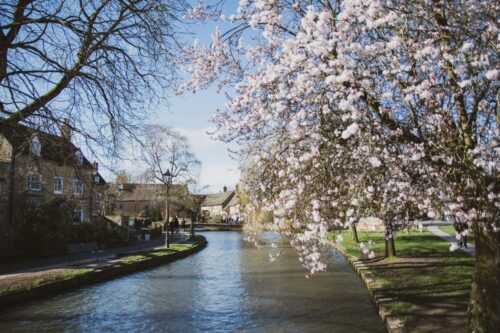
Built on both sides of the River Windrush, Bourton-on-the-Water is undoubtedly the liveliest village in the region. Its small stone bridges, traditional tearooms, and independent shops give it a unique charm.
The village is also known for several unusual attractions, including a 1:9 scale model of Bourton-on-the-Water itself and the Cotswold Motoring Museum, which traces the history of the British automobile. During the summer, locals continue an unusual tradition: a football match is played directly in the river, attracting curious visitors and photographers alike.
Stow-on-the-Wold and Broadway
A former market town specializing in the wool trade, Stow-on-the-Wold has preserved its large market square, surrounded by historic inns, antique shops, and art galleries. St Edward’s Church is famous for its doorway framed by two ancient yew trees, which is said to have inspired some of the enchanted doorways depicted in fantasy literature.
Further north, Broadway is considered one of the most elegant villages in the Cotswolds. Its main street is lined with historic houses, artisan boutiques, and refined cafés. Just a few kilometres away, Broadway Tower overlooks the surrounding countryside and offers exceptional panoramic views across several English counties on clear days.
Day 3: Stratford-upon-Avon, Following in Shakespeare’s Footsteps
Nestled on the banks of the River Avon, Stratford-upon-Avon is world-famous as the birthplace of William Shakespeare in 1564. Its remarkably well-preserved historic centre transports visitors back to Elizabethan England.
A Town Dedicated to England’s Greatest Playwright
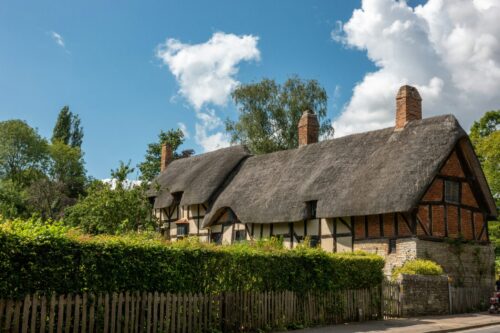
Stratford-upon-Avon is home to several historic properties connected to Shakespeare’s life, including his carefully restored birthplace. Its cobbled streets, timber-framed buildings, and gardens evoke the atmosphere that inspired some of the greatest works of English literature.
Every year, the Royal Shakespeare Company attracts audiences from around the world to performances of Shakespeare’s plays in its modern riverside theatre. This institution plays a major role in the town’s international cultural reputation.
Day 4: Oxford, the City of Dreaming Spires
Renowned worldwide for its university, Oxford is an essential stop for anyone passionate about history and architecture.
Oxford, Where Knowledge Meets Heritage
Founded in the 12th century, the University of Oxford is the oldest university in the English-speaking world. Spread throughout the city, its 39 colleges form an exceptional architectural ensemble where Gothic, medieval, and neoclassical styles blend harmoniously. Visitors can also discover the Bodleian Library, one of Europe’s most prestigious libraries, as well as the famous Radcliffe Camera.
Oxford has also become a must-visit destination for film enthusiasts. Several scenes from the Harry Potter film series were shot at Christ Church and New College, while the city has inspired numerous writers, including Lewis Carroll, J.R.R. Tolkien, and C.S. Lewis.
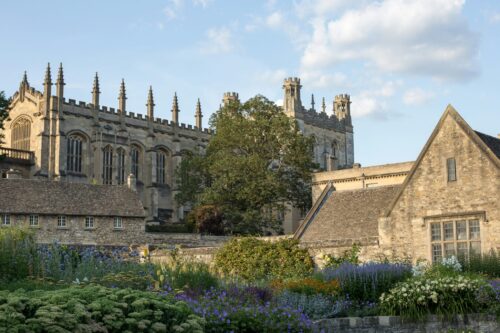
Day 5: Bath, British Elegance
Listed as a UNESCO World Heritage Site, Bath is renowned for its Georgian architecture and its Roman-era thermal baths.
A City Shaped by the Romans
Bath’s natural hot springs were already being used nearly two thousand years ago by the Romans, who built a vast thermal complex there. The Roman Baths, remarkably well preserved, are now among the most visited historic sites in the United Kingdom and bear witness to the city’s importance during Antiquity.
In the 18th century, Bath experienced a new golden age thanks to the British aristocracy, who turned it into a fashionable spa resort. It was during this period that the Royal Crescent, the Circus, and the elegant stone façades for which the city is now famous were built.
The British Art of Living Around Afternoon Tea

No stay in Bath would be complete without enjoying a traditional Afternoon Tea. This custom, introduced in the 19th century by Anna Russell, Duchess of Bedford, was created to bridge the long interval between lunch and dinner.
Even today, tearooms and historic hotels continue this tradition by serving English tea alongside scones with clotted cream and jam, finger sandwiches, and delicate pastries. It is a true institution and an integral part of British culture.
Day 6: Glastonbury, Between History and Legends
Located in Somerset, Glastonbury is one of England’s most mysterious places. Its rich religious heritage and numerous legends make it a fascinating destination.
The Kingdom of Arthurian Legends
The town is closely linked to the legends of King Arthur. According to certain medieval traditions, Glastonbury Abbey is the resting place of King Arthur and Queen Guinevere. Other legends claim that Joseph of Arimathea brought the Holy Grail there after the crucifixion of Christ.
Overlooking the surrounding region, Glastonbury Tor is an iconic hill crowned by the remains of St Michael’s Tower. Visible from several kilometres away, it attracts both hikers and enthusiasts of esotericism. Its spectacular panorama over the Somerset Levels makes it one of the finest viewpoints in southern England.
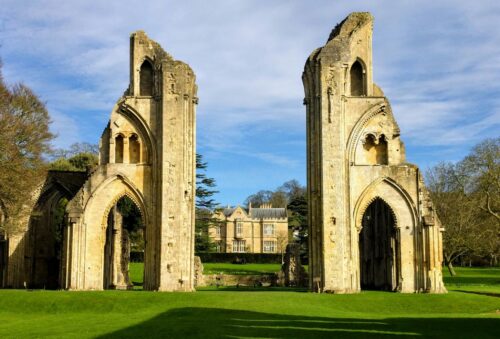
Day 7: Stonehenge and Windsor
Before returning to the airport, this final day of discovery brings together two of Britain’s greatest heritage landmarks.
Stonehenge, the United Kingdom’s Most Mysterious Monument
Built between 3000 and 2000 BC, Stonehenge is listed as a UNESCO World Heritage Site. Composed of massive stone blocks, some weighing more than twenty tonnes, the site continues to fascinate archaeologists and visitors alike.
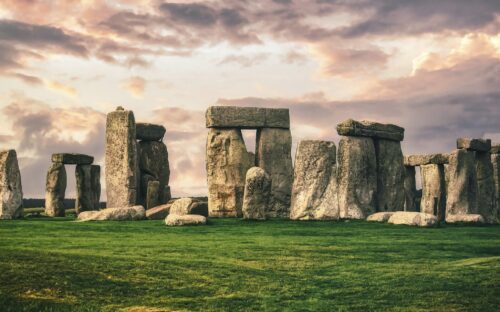
Despite decades of research, many questions remain about its exact purpose. Whether it served as an astronomical observatory, a place of worship, or a ceremonial site, Stonehenge remains surrounded by mystery. Its alignment with the sunrise at the summer solstice nevertheless demonstrates the advanced knowledge of its builders.
Windsor, at the Heart of the British Monarchy
Just a few kilometres from London stands Windsor Castle, the oldest inhabited castle in the world. For nearly one thousand years, it has been one of the official residences of the British Royal Family and remains a powerful symbol of the monarchy.
Built by William the Conqueror in the 11th century, the castle has evolved over the centuries to meet the needs of successive monarchs. Its State Apartments, St George’s Chapel—where several British monarchs, including Queen Elizabeth II, are buried—and its imposing architecture attract millions of visitors every year.
Day 8: Departure
After breakfast, your private transfer takes you to the airport for your return flight. You leave England with lasting memories of its unspoiled countryside, timeless villages, prestigious historic cities, and some of the United Kingdom’s most iconic landmarks.
Why Choose This English Countryside Tour?
This itinerary offers the perfect balance of heritage, nature, and British traditions. From the picturesque villages of the Cotswolds to the elegant streets of Bath, from the colleges of Oxford to the mysteries of Stonehenge, each day reveals a different facet of England.
At Trip My France, we carefully select accommodations, experiences, and itineraries to create tailor-made, authentic, and comfortable journeys. This eight-day tour is ideal for discovering the very best of the British Countryside, while enjoying a relaxed pace and personalized service.
Let yourself be captivated by this authentic England, where every village, every castle, and every landscape tells a story that is centuries old.